This is significant and timely. Be sure to read the “analysis” (click on the word) --it is an interesting analysis of the problems inherent in US and Israel policy and inaction with regard to the rights of Palestinians.
Also of interest is a video (referred to in the analysis) of Prime Minister Benjamin Netanyahu talking with an Israeli family, bragging about how he is manipulating and taking advantage of US aid. It’s very disturbing. If you have not seen it on YouTube yet, it is well worth watching. This article from Ma’an News Agency includes both the video and a transcript of what Netanyahu is saying: http://www.maannews.net/eng/ViewDetails.aspx?ID=300732
From the Washington Report on Middle East Affairs, forwarding the information from the Council for the National Interest Foundation-----
.
Dear Friends,
We have disturbing and urgent news. Our new executive director, Philip Giraldi, and other former U.S. intelligence officers have just published an extremely important analysis warning that Israel may plan to attack Iran as early as this month (full-length article below).
They detail the evidence for this possibility and warn that such an action would quite likely drag the United States into yet another tragic, needless, and disastrous quagmire. It would be a war that Israel would begin and the United States would have to finish.
Fortunately, they also describe actions that President Obama could take to prevent this.
1. We urge you to circulate this information widely.
2. Also, please contact the White House and your Congressional representatives to tell them that you do not want another costly and profoundly tragic war. Explain that you desire that the U.S. issue a clear demand that Israel NOT attack Iran and instead allow the various excellent diplomatic initiatives to defuse the situation to move forward.
Our radio program “CNI: Jerusalem Calling” will discuss this topic TODAY at noon eastern time. CNI President Alison Weir will be the host with Executive Director Philip Giraldi and CIA intelligence officer Raymond McGovern as the guests. Mr. McGovern served as an intelligence officer in the CIA for almost thirty years and prepared the President’s Daily Brief during both the Reagan administration and the first Bush administration. He has also published a number of articles and is one of the founding members of Veteran Intelligence Professionals for Sanity (VIPS), a group of former and current officials in the intelligence community that got together in 2003 to protest the use of faulty intelligence leading up to the Iraq War.
To listen: go to the show’s homepage and click on the “Listen Live” button for Studio A, at the top left.
Below is the article, by Ray McGovern:
MEMORANDUM FOR: The President
FROM: Veteran Intelligence Professionals for Sanity (VIPS)
SUBJECT: War With Iran
We write to alert you to the likelihood that Israel will attack Iran as early as this month. This would likely lead to a wider war. Israel’s leaders would calculate that once the battle is joined, it will be politically untenable for you to give anything less than unstinting support to Israel, no matter how the war started, and that U.S. troops and weaponry would flow freely. Wider war could eventually result in destruction of the state of Israel. This can be stopped, but only if you move quickly to preempt an Israeli attack by publicly condemning such a move before it happens.
We believe that comments by senior American officials, you included, reflect misplaced trust in Israeli Prime Minister Netanyahu. Actually, the phrasing itself can be revealing, as when CIA Director Panetta implied cavalierly that Washington leaves it up to the Israelis to decide whether and when to attack Iran, and how much “room” to give to the diplomatic effort. On June 27, Panetta casually told ABC’s Jake Tapper, “I think they are willing to give us the the room to be able to try to change Iran diplomatically … as opposed to changing them militarily.”
Similarly, the tone you struck referring to Netanyahu and yourself in your July 7 interview with Israeli TV was distinctly out of tune with decades of unfortunate history with Israeli leaders. “Neither of us try to surprise each other,” you said, “and that approach is one that I think Prime Minister Netanyahu is committed to.” You may wish to ask Vice President Biden to remind you of the kind of surprises he has encountered in Israel.
Blindsiding has long been an arrow in Israel’s quiver. During the emerging Middle East crisis in the spring of 1967, some of us witnessed closely a flood of Israeli surprises and deception, as Netanyahu’s predecessors feigned fear of an imminent Arab attack as justification for starting a war to seize and occupy Arab territories. We had long since concluded that Israel had been exaggerating the Arab “threat” – well before 1982 when former Israeli Prime Minister Menachem Begin publicly confessed: (read more.....)
Thursday, August 5, 2010

Wednesday, July 28, 2010
Almost Forgotten
One of the really frustrating things about working for justice for Palestinians is the way our U.S. mainstream news covers Palestinian stories so poorly. One little-known story from the attack on the Free Gaza flotilla is that one of the nine victims was a U.S. citizen. Furkan Dogan was born in the U.S.; when he was two, his family returned to Turkey, where he grew up. He was nineteen; he had just graduated from high school and planned to become a doctor. He responded to an online invitation and won a lottery to join the flotilla, which was bringing humanitarian aid to Gazans (photo is Furkan's picture).
If he had been white, would we have heard more about him in our news? If his family had been British, living briefly in the U.S. when he was born, would our news media have covered the story? I can imagine that our local Denver news channels would have headlined his story if he had lived in Denver—and if he were white. I wonder if his being Muslim and Turkish had an effect on the lack of information about him in U.S. news?
Roger Cohen, an op-ed columnist for the New York Times, introduces us to Furkan in his Monday column:
TROY, New York — The Dogans were a quiet family little noticed by their neighbors here in upstate New York. Ahmet Dogan had come to the area from Turkey to study accounting at the Rensselaer Polytechnic Institute.
See photos of the other victims of the attack: http://www.flickr.com/photos/freegaza/

If he had been white, would we have heard more about him in our news? If his family had been British, living briefly in the U.S. when he was
 born, would our news media have covered the story? I can imagine that our local Denver news channels would have headlined his story if he had lived in Denver—and if he were white. I wonder if his being Muslim and Turkish had an effect on the lack of information about him in U.S. news?
Roger Cohen, an op-ed columnist for the New York Times, introduces us to Furkan in his Monday column:
TROY, New York — The Dogans were a quiet family little noticed by their neighbors here in upstate New York. Ahmet Dogan had come to the area from Turkey to study accounting at the Rensselaer Polytechnic Institute.
He was a serious student; the Dogans did little entertaining. But when their younger son, Furkan, was born in 1991, the family threw a party and a neighbor recalled a toast “to the first U.S. citizen in the family.”
Furkan Dogan would live just two years in Troy, returning to Turkey with his family in 1993. But he was proud of his American passport and dreamt of coming back after completing medical school. Five Israeli bullets — at least two of them to the head — ended that dream on May 31. Dogan was 19.
See photos of the other victims of the attack: http://www.flickr.com/photos/freegaza/
Bishop Munib Younan Elected President of Lutheran World Federation
Bishop Younan is bishop of the Evangelical Lutheran Church of Jordan and the Holy Land (ELCJHL). His work in building relationships among religious leaders of varied faith traditions - in Palestine and Israel - is cited in the announcement of his election . His election affirms the important leadership role of Palestinian Christians in peacemaking and reconciliation work. Be sure to click on the full news release to read more about his work.
Here is the press release about the election, from the Evangelical Lutheran Church in America:
STUTTGART, Germany (ELCA) -- The Rev. Munib A. Younan, bishop of the Evangelical Lutheran Church of Jordan and the Holy Land (ELCJHL), has been elected president of the Lutheran World Federation (LWF) July 24 at the LWF Assembly here. Younan received 300 votes affirming his election, 23 against and 37 abstentions. There were no other nominees.
More http://www.elca.org/News/Releases.asp?a=4594
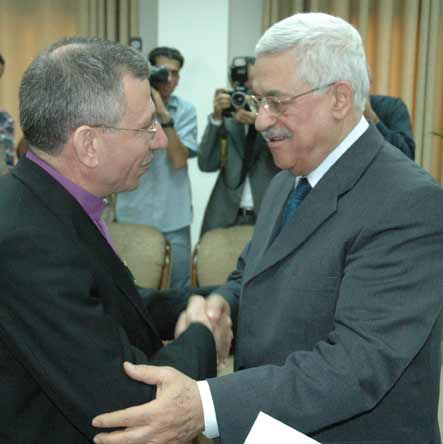 . His election affirms the important leadership role of Palestinian Christians in peacemaking and reconciliation work. Be sure to click on the full news release to read more about his work.
Here is the press release about the election, from the Evangelical Lutheran Church in America:
STUTTGART, Germany (ELCA) -- The Rev. Munib A. Younan, bishop of the Evangelical Lutheran Church of Jordan and the Holy Land (ELCJHL), has been elected president of the Lutheran World Federation (LWF) July 24 at the LWF Assembly here. Younan received 300 votes affirming his election, 23 against and 37 abstentions. There were no other nominees.
More http://www.elca.org/News/Releases.asp?a=4594
Thursday, July 8, 2010
From Jerusalem - Today 20,000 people marched for Gilad Shalit's release
This news comes from Yael Pettreti, who was one of the leaders of our Compassionate Listening delegation in May-June. Our delegation stood with the demonstrators at Sheikh Jarrah at their regular Friday demonstration. We watched the families as they walked, accompanied by an exquisite drumming group--very lively and contagious. We also heard from Nasser Ghawi, who talked about the weekly demonstrations and the problems the families are facing as they are being evicted from their homes in East Jerusalem so that Jewish settlers can move in. Nasser's father made an agreement with the government of Jordan and with the UN-- in 1952, Jordan provided the land and the United Nations built 28 houses. Nasser's father exchanged his refugee card for the house and the government promised to convert the title. After many years of court appearances, he is still fighting for his home. The photo shows the Palestinian families marching in Sheikh Jarrah, with Israelis and international volunteers, when we were there in May.
Yael reports from Jerusalem today that these families are supporting the demonstrations for the release of Israeli soldier Gilad Shalit:
"This evening, about 20,000 people marched for Gilad Shalit's release from Hamas captivity. They marched into Jerusalem to be met by thousands more in Independence Park. Among the marchers were the Palestinian families evicted from their Sheikh Jarrah homes. Nasser Ghawi persuaded them to join the marchers as a way of "reaching out in peace." I told him what a beautiful and very smart thing to do it was.
As people were gathering in Independence Park, I spotted Noam Shalit, Gilad's father, behind the stage. I went to him and told him about the Palestinian families. He said that he and the rest of the family did not distinguish between different religions or ethnic groups. He asked me to thank them for him.
Now the family is settling in just across from Netanyahu's house, vowing that they will not leave without Gilad. We are all praying that it will be soon.
Blessings,
Yael
"Mitakuya oyasin." ("All beings are my relatives.") - Lakota
 in 1952, Jordan provided the land and the United Nations built 28 houses. Nasser's father exchanged his refugee card for the house and the government promised to convert the title. After many years of court appearances, he is still fighting for his home. The photo shows the Palestinian families marching in Sheikh Jarrah, with Israelis and international volunteers, when we were there in May.
Yael reports from Jerusalem today that these families are supporting the demonstrations for the release of Israeli soldier Gilad Shalit:
"This evening, about 20,000 people marched for Gilad Shalit's release from Hamas captivity. They marched into Jerusalem to be met by thousands more in Independence Park. Among the marchers were the Palestinian families evicted from their Sheikh Jarrah homes. Nasser Ghawi persuaded them to join the marchers as a way of "reaching out in peace." I told him what a beautiful and very smart thing to do it was.
As people were gathering in Independence Park, I spotted Noam Shalit, Gilad's father, behind the stage. I went to him and told him about the Palestinian families. He said that he and the rest of the family did not distinguish between different religions or ethnic groups. He asked me to thank them for him.
Now the family is settling in just across from Netanyahu's house, vowing that they will not leave without Gilad. We are all praying that it will be soon.
Blessings,
Yael
"Mitakuya oyasin." ("All beings are my relatives.") - Lakota
Tuesday, July 6, 2010
From Israel—just north of the Gaza Border, June, 2010
Last week the US Senate passed Sen Res 548, a resolution supporting Israel’s right to defend itself and condemning the “destabilizing actions by extremists aboard the Mavi Marmara.” Both Colorado senators, Bennett and Udall, voted for it. The resolution contains much language about Israel’s “inherent and undeniable right to defend itself,” and calls Hamas a terrorist group—pursuing foreign policy by name-calling.
One of the “Whereases” of the resolution mentions the “approximately 860,000 Israeli civilians [who] reside within range of rockets fired from Gaza and live in fear of attacks.” Fortunately, some of these Israelis are not satisfied with name-calling.
Roni Keider and Julia Chaitin, met with our Compassionate Listening Project delegation in June. Roni and Julia live in Moshav Netiv-haAsara (a moshav is like a kibbutz, but the families do not pool all their money). They live on Israeli land, given to Israel in the armistice of 1949. Israel’s security wall, separating Israel from Gaza, forms the boundary of one of the neighborhoods. The moshav has decorated the wall on their side. (see picture)
Roni and Julia are part of a group called Other Voice, meeting with Palestinians from Beit Hanoun and Beit Lahiya, just on the other side of the wall. The moshav was founded in 1982, as a buffer between Israel and the Gaza Strip. As we sat in their community room, having cold drinks and cookies, the women told us what to do if the sirens sounded. Basically, we would follow them to the shelter. The warning sirens give them fifteen seconds to get to shelter before the rockets land.

They told us that ten years ago life became more difficult here—before that Palestinians had worked at the moshav and Jewish and Palestinian families knew one another and celebrated together. They thought that when Israel withdrew from Gaza in 2005, they would have peace. But the day after withdrawal, a rocket fired from Gaza killed Roni’s daughter’s best friend, Dana Galkowicz.
Roni also told us about living in Egypt, where her daughter became best friends with a Palestinian girl. It took three years, but finally, because the girls, Heba and Imbaa, were persistent, their families, too, became friends. (photo shows buffer zone between Netiv-haAsara and Gaza)
Julia, a professor at Sabir College near Sderot, told us about the two students who were killed two years ago in the parking lot, while other students watched. The effect of the rocket attacks on these Israelis is devastating. She told us that 75-80% of Israelis have PTSD, a result of living with the constant fear of the rocket attacks and seeing or knowing people who have been injured or killed.
Her story is like so many I have heard from Israelis. At one time she believed that Israel only wanted peace. She believed that the land was empty when the state of Israel was formed in 1948. She also believed that the Arabs hated the Jews. Then she learned about the history—the forced removals of Arabs from their villages in 1948, and the massacres of Palestinians. And she realized that the Palestinians and the Jews need one another in this arid part of the world. So she joined Other Voice (http://www.othervoice.org/welcome-eng.htm ), a group that builds friendships between Israelis and Palestinians. She stays in touch with friends in Gaza by email and speakerphone these days. They put the cell phone on the floor in the middle of the group and talk with their friends in Gaza. They have not seen one another since Operation Cast Lead in 2009.

While they used to get together in person, now she plays Farmville with her friends on Facebook. She was opposed to Israel’s attack on Gaza and she is opposed to the security wall, which is supposedly being built for her protection (read Other Voice’s statement). When one of her friends from another moshav protested the killings of the nine people on the Free Gaza flotilla, she was threatened by one of her neighbors who called her on the phone and told her to apologize or she would be forced out of the moshav—a frightening prospect for a single mother. (photo shows Julia and Roni)
Julia told us they won’t give up “because there is no other way” to live. She told us to support peacebuilding groups in Israel because this is really what it means to be pro-Israel. Regarding comparisons between the Holocaust and the Occupation, she says, “I don’t have to compare. I cannot because we know what this (occupation) is doing to us as a people.” She said it is easier to talk to Palestinians than it is to have a dialogue about Israel’s policies with other Israelis. She said it is easier for Israelis see themselves as the victims because then they are not responsible. “Both peoples are entitled to land and life; both have a right not to be bombed….We know what we have to do; we just have to do it; we need to know how to listen and talk to one another.” She does this for her thirteen grandchildren, “so they will have a good life.”
Read Julia’s article about the Israeli attack on the Free Gaza flotilla in the Berkeley Daily Planet.
People killed in Gaza, January 91, 2009 (the date of the Operation Cast Lead ceasefire) to May 31, 2010 (from B’Tselem):
As in most stories from Israel and Palestine, there is suffering on both sides of the wall. For the past sixty years, the suffering of the Palestinians, however, always seems to be greater. While there have been deaths from the rocket attacks on Israelis living just north of Gaza, there have been many more deaths of Palestinians in Gaza. During the past year and a half, while 4 Israelis were killed by Palestinians in ALL of Israel (2 in Israel and 2 in the West Bank), 56 Palestinians were killed in Gaza by Israelis; an additional 24 were killed in the West Bank.
Subscribe to:
Posts (Atom)